
How it works
Upload a certificate. Get an answer you can defend.
Five stages. The important one is the third, where the system is as willing to say it cannot establish a requirement as it is to say a result passed.
Upload
A PDF or a scan of the certificate.
The file goes to your organisation's own storage. It is never pooled with another customer's documents, and it is not used to train anything.
Stamped, photographed and low-resolution certificates are the normal case rather than the exception, so a page that is sharp but small is enlarged and read instead of being rejected.
Read
Values are extracted, then checked before anyone judges them.
Each value is tested against the page it claims to come from, the cell it claims to occupy, and a confidence floor. A number that cannot be traced back to the document does not continue.
If the page genuinely cannot be read, the run stops and says so. It does not produce a report full of blanks that looks like a set of failures.
Compare
Verified values are measured against the requirements that apply.
Requirements come from a controlled register in which every entry carries its version. Where no requirement can be established, the report records that as an open item rather than inventing a limit.
The printed limit and the official limit are compared separately from the result itself, because a certificate promising less than the requirement is a different problem from a batch that failed.
Report
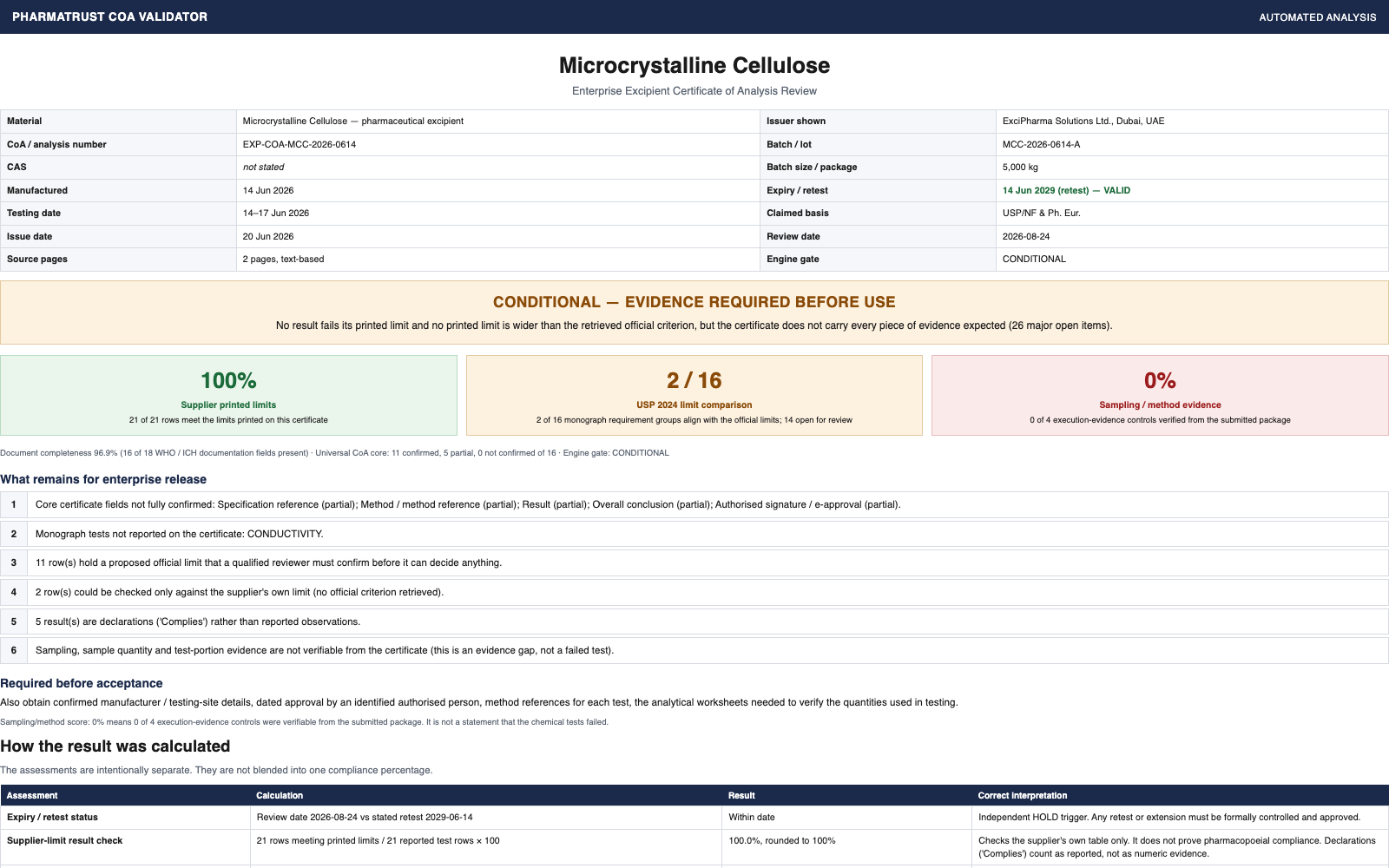
A fixed seven-section report, in HTML and PDF.
Every finding states the requirement, the evidence on the certificate, the reasoning, the source and its version, and the action that would close it.
A report whose headline numbers cannot be recounted from the rows beneath them is not published at all; the run is kept and the failure is reported.
Review
A qualified person decides.
The analysis supports the decision; it does not make it. A reviewer can confirm or correct the findings with cited sources and issue an Expert-Reviewed Analysis.
Corrections are appended rather than overwriting history, so why something changed remains visible.
The rule that shapes all of it
A confident wrong answer is worse than no answer. Every design argument in this system is settled that way: where the evidence does not support a conclusion, the report says what is missing instead of producing something that reads like certainty.
Questions
How long does an analysis take?
Minutes rather than hours for a typical certificate. A multi-page scan takes longer than a digital PDF because each page has to be read before anything can be judged.
What if the analysis gets something wrong?
Automated analysis may contain errors and may not detect every problem, which is why qualified review sits at the end of the workflow rather than being optional. Where a reviewer corrects a finding, the correction is recorded against the run.
Can I re-run an analysis?
Yes. Re-judging uses the stored reading and does not consume your monthly allowance again. Re-reading the document from scratch is a separate, billable action.
Validate a certificate now
Five automated analyses free in your first month, then three every month. No card required.